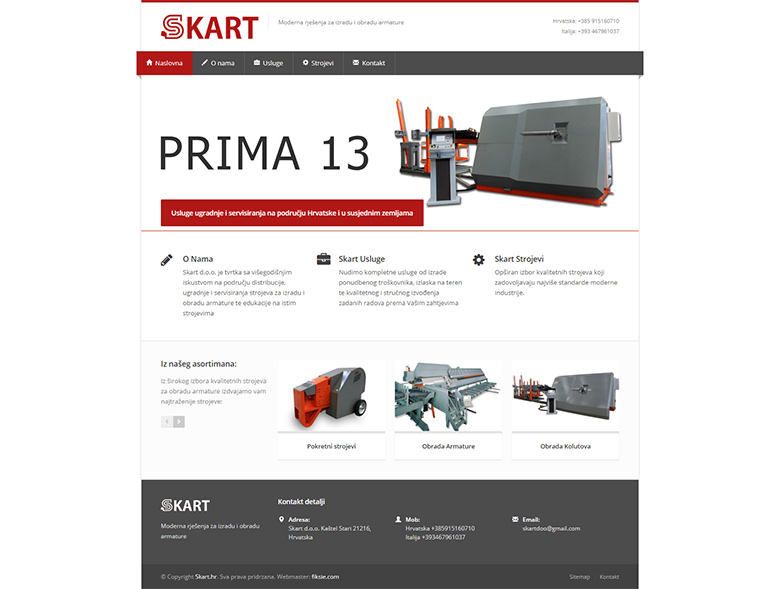
When you choose an html css website, you’re selecting a path of simplicity, performance, longevity and peace of mind—and that is exactly what the site for Skart d.o.o. (skart.hr) offers. In this article, we’ll explore why building the site with plain HTML and CSS templates was a smart move, how it continues to serve the business with minimal effort, and why for a site that functions primarily as an online business card rather than a constantly changing portal, this approach is highly effective.
Table of Contents
The Business Context: skart.hr
Before diving into the technical details, let’s recall the context. Skart d.o.o. sells and maintains machines for bending mesh, extruding steel bars, and related industrial hardware. skart.hr is not a large e-commerce store; rather it is a brochure-style site that presents their services, lists the machines, offers filtering by tags so that visitors can quickly find relevant machine types, and acts essentially as the company’s online face.

Because of this business model, a lean website built with basic web technologies is exactly the right fit. It avoids the overhead of a heavy system, allows for fast loading, minimal maintenance, and predictable behaviour.
What we mean by an “html css website”
An html css website in this context means a website built primarily with static HTML files (i.e., pages whose markup is pre-written) and CSS for styling. There is little or no server-side dynamic content generation (e.g., no heavy CMS, no frequent database calls, no complicated JavaScript frameworks managing content). The templates are simple, the structure is straightforward, and every page is essentially ready to serve.
The advantages of this approach are manifold—and in the case of skart.hr they have really shown themselves over the years.
Why this approach suits skart.hr so well
1. Very low maintenance burden
One of the key selling points of an html css website is that once built, it rarely (if ever) needs major technical upkeep. For skart.hr, the site was built 14 years ago and has never required any maintenance except when the company moved to a different hosting provider. That’s quite remarkable for a functioning business site.
Because the codebase is simple (just HTML/CSS), there are no moving parts, no frequent security patches for plugins, no database migrations, and no dependency updates for frameworks. This means the site simply works, reliably, year in and year out.
2. High speed and performance
With an html css website, you are serving static files (HTML + CSS + maybe a little JavaScript) directly to visitors. That means no waiting for server-side rendering, no database queries, and generally very fast load times. According to multiple sources:
- Static sites skip server-side rendering or database lookups, and so deliver content quickly.
- They make excellent use of CDNs (Content Delivery Networks) and caching.
For skart.hr, fast loading means potential clients can browse the machine listings and filtering options without delay — which enhances user experience and trust.
3. Minimal technical debt
Technical debt comes from complex systems, frameworks, plugins, third-party libraries, and frequent updates. With an html css website, you avoid much of that. The code is simpler, easier to understand, and you do not have to worry about upgrading frameworks, concerns about version mismatches, or plugin breakages. In short: less overhead, fewer surprises.
4. Longevity and reliability
The fact that skart.hr was built 14 years ago and still runs with virtually no maintenance is testimony to the longevity of the html/css model. When nothing changes rapidly, when the site is more like an online business card than a rapidly evolving shop front, this approach shines.
5. Better control and fewer dependencies
Modern web frameworks often generate static HTML+CSS eventually — but carry a heavy weight of dependencies (JavaScript libraries, frameworks, build systems). With a pure html css website, you skip all that: you already have the static site, you already control the markup, you don’t depend on constant updates of JavaScript frameworks. This gives you fewer points of failure and fewer things to worry about.
6. Ideal for the business use-case
Because skart.hr is not a high-traffic interactive portal requiring frequent content changes, user subscriptions, complex database management, this static approach is ideal. The filtering options via tags still can be implemented on top of static pages (for example via simple JavaScript or pre-rendered filtering) but the core remains simple. When your business model is “we sell and maintain machines — here are the machines, here’s who we are, contact us” — a static site is entirely appropriate.
The filtering feature: enhancing the static site
One might ask: “Wait — if the site is static, how do we support filtering options via tags so that every type of machine can be filtered?” The answer is: even static sites can implement client-side filtering (via simple JavaScript) or pre-generated lists that let users pick tags and then navigate to relevant pages. Because the underlying pages are static HTML, implementing tag-based filtering is very feasible, without the need for a heavy CMS or server backend. This means that skart.hr combines the benefit of static simplicity with useful functionality for machine-buyers (filtering by machine types) in an efficient way.
The broader context: modern frameworks still serve static HTML/CSS
An important trend to note: even modern web frameworks today often compile (build) down to static HTML/CSS (plus some JavaScript) for rendering. This means that whether you use say React, Vue, Svelte, Next.js, or whatever, ultimately your site is served as HTML/CSS to the browser. What that means for skart.hr is: you already have that “final product” — a static HTML/CSS website — without needing to carry the extra baggage of a full JavaScript-framework environment.
In other words: if you were to rewrite the site with a modern framework, you might end up with exactly the same output (HTML + CSS) plus extra dependencies, build pipelines, etc. But you wouldn’t get much additional benefit given the business use-case. So the decision to stay with an html css website is both sensible and efficient.
Key advantages of html css websites — summarized
To recap, here are the main advantages of an html css website (and how they apply to skart.hr):
- Speed / Performance: pages load fast, user waits less, bounce rates lower.
- Security: fewer attack vectors, no database, minimal server‐side code.
- Low maintenance: minimal updates, fewer moving parts.
- Lower hosting cost: simpler hosting, fewer resources required.
- Reliability and scalability: static files easily served; traffic spikes handled better because no dynamic generation.
- Clean HTML/CSS code and fewer dependencies: control remains with you, not large frameworks.
- Suitability for the use case: for a “business card” type site, static works perfectly, rather than heavy CMS.
Why moving to another platform would introduce more overhead
If skart.hr were to move to a modern CMS or heavy JavaScript framework (for example to support large-scale e-commerce or lots of dynamic interactivity), they would incur several costs:
- Additional dependencies (JavaScript frameworks, libraries) that need updating regularly.
- Plugin or module versions that must be maintained and can break.
- More complicated hosting needs, possibly databases and backend server logic.
- More potential security vulnerabilities and more frequent maintenance.
So unless the business demands those features (which currently it doesn’t), sticking with an html css website is not just simpler — it’s smarter.
Practical implications for skart.hr
Minimal changes, maximum stability
Since the original build (14 years ago) the site has only needed attention when changing host. That means no mid-year migrations, no plugin conflicts, no lost content due to updates gone wrong. This gives the company time to focus on what matters — selling and servicing machines — rather than the website.
Easy hosting migration
When the time came to move hosting providers, the static HTML/CSS structure allowed a smooth transition. Since the site does not rely on server-side code or complex database structure, hosting migration is comparatively trivial: copy the files, point the domain, configure DNS, done.
Smooth filtering and navigation
The filtering options by tags (for machine types) work efficiently on a static site because each “machine type” page or section can be pre-rendered or filtered on the client side. Because the underlying HTML is available and straightforward, the user experience is snappy.

Focus on business content, not tech overhead
With minimal tech overhead, the company can concentrate on core content: machine descriptions, tagging, services, contact information, and customer relationships. The website becomes a reliable asset, not a liability requiring constant upkeep.
When an html css website might not be the best approach
It’s worth acknowledging that while html css websites offer many advantages, they are not universally optimal. If your business requires heavy dynamic interaction (user accounts, e-commerce checkout with product catalog changes, frequent daily content updates, real-time data display, or personalization), then a more dynamic approach might be justified. Static sites have limitations such as:
- Less suited to frequent content updates or huge sites (each page may need manual editing)
- Limited user interaction capabilities out-of-the-box (forms, user profiles, dynamic content)
- Content management can become tedious if many pages and frequent updates are needed
In the case of skart.hr, however, none of these drawbacks meaningfully apply — the site is relatively stable in structure, not huge in scale, and functions well as an informational and product-listing platform.
The business model match: skart.hr and static site harmony
Let’s reiterate why the business model of Skart and the static html css website model are in harmony:
- The company sells machines (bending mesh, extruding steel bars, etc.). The list of machines changes occasionally — but not daily.
- The site acts as an online brochure or business card: it presents the company, the machines, the services, the contact info.
- Users come to browse machine types, filter by tags (e.g., bending, extruding, mesh, steel bar) and contact the company for purchase or service.
- The company wants a stable, easy-to-maintain web presence without worrying about technical debt or frequent updates.
All of this maps perfectly to an html css website.
SEO, speed, and user experience benefits
From the SEO and user experience perspective, an html css website has distinct advantages:
- Search engines favour fast-loading sites; static sites deliver that.
- Clean markup and fewer dependencies mean search crawlers get to the content faster; less JavaScript overhead means better crawlability. Reddit users and developers often note: “A static page is always going to be faster than a page that loads a bunch of libraries to render HTML.
- Fewer technical issues mean fewer risks of downtime or broken pages.
- For users browsing machine listings, filtering, and contacting the business, fast load times and reliable navigation matter — they reflect professionalism and responsiveness.
Addressing the question of “modern frameworks vs static HTML/CSS”
Many people ask: “But modern frameworks exist — why not use them?” Here’s how to think about it:
- Frameworks (React, Vue, Svelte, Next.js, etc.) offer advantages if you need complex interactivity, dynamic data, web apps, real-time features.
- But if you don’t need all that, frameworks often introduce extra build tooling, dependencies, potential for version conflicts, and extra work.
- In many cases those frameworks output static HTML/CSS (especially when using Static Site Generators). So you’re effectively getting what you already have — static pages — but with overhead.
- Since skart.hr already uses a simple html css model, it doesn’t need to deal with the dependencies of JS libraries, build pipelines, plugin upgrades, etc. It takes advantage of the “same output” but with far less overhead.
In short: if you don’t gain meaningful additional functionality from a framework, going with plain HTML/CSS is a sensible, cost-effective choice.
Practical tips for maintaining an html css website like skart.hr
Since skart.hr is already running smoothly, here are a few practical maintenance tips (even though maintenance is minimal):
- Keep backups of the HTML/CSS files — even though nothing changes often, having a versioned backup ensures peace of mind.
- Ensure hosting and DNS remain current — since the site is static, the biggest risk is domain expiry, hosting changes, or DNS mis-configuration.
- Optimize for mobile and performance — since the site uses HTML/CSS, make sure the CSS is lean, semantic HTML used, images are optimized, caching is configured. According to the research, optimizing HTML/CSS improves speed significantly.
- Periodic content review — even though the structure is stable, every so often review that machine listings, tag filters, contact info are up to date. The static site makes this easy.
- Security hygiene — even though static, ensure your hosting environment uses SSL/TLS, your file permissions are set correctly, and your domain registrar account is secure. The attack surface is low, but good practice remains.
- Consider a CDN or edge hosting — If you aren’t already using one, hosting static files on a CDN further improves global performance and resilience.
Reflections on 14 years of stable service
It’s worth highlighting just how impressive it is that skart.hr, built 14 years ago, still runs with almost no modifications. That is exactly the kind of outcome one expects from an html css website when the business requirements are stable. The benefits compound over time: fewer maintenance hours, fewer surprises, a stable online presence that simply works.
This longevity also speaks to the wisdom of choosing the right tool for the job. If the business had insisted on a trendy CMS or heavy JavaScript framework 14 years ago, they might now be dealing with plugin compatibility issues, outdated libraries, migrations, lost content. Instead, they invested in something stable, durable, and resilient.
Summary
Building a html css website for skart.hr was not just a technical decision—it was a business decision aligned with the company’s needs. In summary:
- The site is lean, with minimal dependencies, meaning the business doesn’t spend time or money on upkeep.
- It loads quickly, giving users a smooth experience and supporting search engine optimisation.
- It avoids the complexity, technical debt, and risk associated with heavy frameworks or CMS platforms.
- It suits perfectly a stable business model: machine sales and maintenance, where the website is an informational heart rather than a rapidly changing portal.
- Because modern frameworks ultimately output HTML/CSS anyway, the company effectively already has the benefits of static site delivery without the overhead of managing a large JavaScript ecosystem.
- The filtering by tags, as offered on the site, demonstrates that static HTML/CSS doesn’t mean “dumb” or “simple” — it means efficient, well-chosen simplicity.
Final thoughts
If you are facing a decision about how to build or maintain a website, especially for a small business or company site that does not need frequent content changes or complex interactions, consider the html css approach. As skart.hr demonstrates, when you choose simplicity and the right architecture for your business, you gain reliability, speed, lower cost, and less hassle.
For Skart d.o.o., their website is working reliably, and continues to serve their business day after day with minimal effort—14 years and counting. That’s the power of choosing the correct structure: a simple html css website that matches business need, rather than over-engineering for features not required.
If you’d like, I can provide a breakdown of the code architecture (templates, CSS strategy, filter implementation) used on skart.hr — just let me know!