Schema Markup Ireland: Helping Google Make Sense of Your Business
If you run a business in Ireland, you have probably heard someone mention schema markup, structured data, or local business schema during a website or SEO project. It can sound like something that belongs in the developer section of your website rather than something a business owner needs to think about.
In reality, the idea is fairly simple. Schema markup gives search engines extra information about what your website is actually talking about. It can tell Google that a page represents a dentist in Cork, a restaurant in Galway, a solicitor in Dublin, or a particular product being sold through an online shop.
That extra context can matter because Google is not simply matching words on a page. It is trying to understand businesses, places, products, services, prices, opening hours, reviews and other details so that it can present useful information when someone searches.
In This Article We Cover:
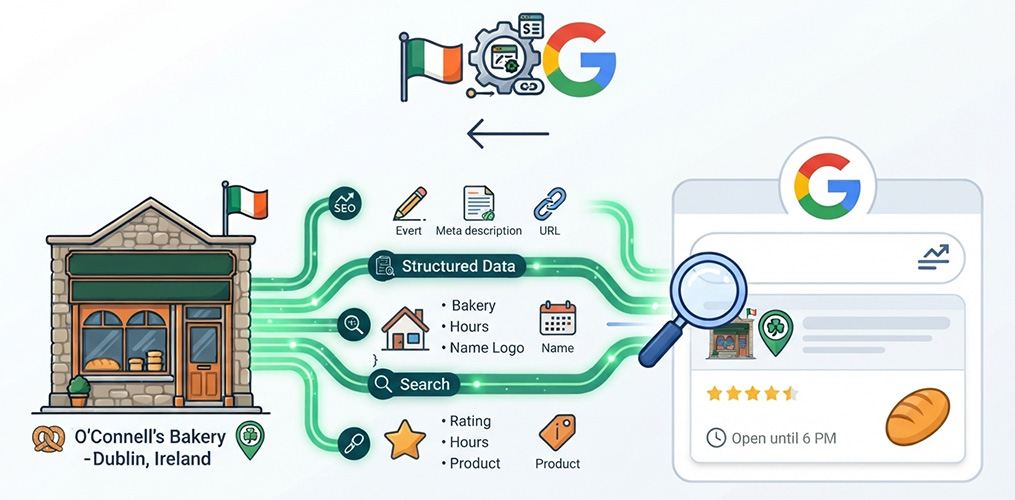
Schema does not guarantee higher rankings, a place in Google Maps, review stars, or an appearance in an AI answer. It is better thought of as a way of giving search engines clearer information to work with. When it is implemented properly, it can also make your website eligible for richer search features that a normal page may not qualify for.
Local Business Schema for Irish Businesses
Think about what happens when someone searches for a local business. They might type “dentist Dublin 4”, “plumber near Limerick”, “Italian restaurant Galway”, or simply search for the name of a business they have heard about.
Google needs to work out what the business is, where it is located, what it does, when it is open, and whether the information on different websites refers to the same organisation. Your website already contains much of this information, but structured data gives Google a more organised way of interpreting it.
For a local business, this can include details such as the business name, address, phone number, opening hours, website address, logo, geographical location and the more specific type of business. Google recommends using the most specific LocalBusiness type that applies. A restaurant, for example, can be described as a Restaurant rather than simply being labelled as a generic local business.
For an Irish business, the address information deserves particular attention. Your website might say that you are based at 25 Main Street, Cork, while another page spells the business name differently or uses an old address. Your structured data should reflect the real business details accurately, including the correct town, county where appropriate, postcode information and Eircode where it forms part of your published address.

This is one of the less glamorous parts of schema work, but it is often where the practical value lies. Adding more fields is not automatically better. If structured data tells Google that you are open until 9pm when your actual opening hours are 6pm, you have simply given a search engine better organised wrong information.
That is why good schema implementation is not just a matter of copying a piece of code into WordPress. Someone needs to decide what the business actually is, which information belongs to it, which pages describe that information, and whether the details match what customers see on the page.
Schema Markup and Google Maps
There is an important distinction worth making here because schema is sometimes presented as a magic route into Google Maps. It is not.
Your Google Business Profile is still a major part of how your business information appears across Google Search and Google Maps. Local business structured data on your website does not replace your Business Profile, and adding schema does not mean Google will automatically move your business higher in the local results.
What schema can do is give Google another clear source of information about the business represented by your website. Google says LocalBusiness structured data can provide details such as opening hours, departments and other business information, and local businesses can be eligible for certain search features when the relevant requirements are met.
This matters particularly when your website is an important source of information about the business. Imagine a plumber serving customers across Dublin. The website might contain the company name, service areas, phone number, address, opening information and descriptions of the services provided.
Without structured data, Google can still read those words. With correctly implemented structured data, the same information is presented in a format that machines can interpret more consistently.
For the business owner, the useful way to think about this is not “schema gets me into Maps”. A better question is “have I made it as easy as possible for Google to understand who my business is and what information my website is providing?”
Why Search Results Can Look Different With Schema
One of the most visible reasons businesses hear about schema is rich results. These are search results that can contain more information than the standard blue link, depending on the type of content and whether Google chooses to show the relevant feature.
For products, that information can include things such as price, availability, ratings and review information. For suitable local business pages, structured data can help Google understand business information that may be used in supported search experiences.
There is an important word in that explanation: eligible. Schema does not tell Google, “show this exact design in the search results”. It tells Google what the information means and can make the page eligible for certain search appearances.
Google still decides whether and how to display the information. Search results can change, and not every page with valid schema will receive a rich result.
There is also a common misunderstanding around review stars. Many business owners assume that adding an aggregate rating to their own local business page will automatically make gold stars appear beside their Google reviews in organic search. That is not how Google’s current guidelines work.
Google has specific restrictions around review snippets for local businesses. In particular, a business generally cannot use self controlled reviews about itself as the source for the star review feature on pages marked up as that organisation. Reviews need to meet Google’s requirements, including being sourced directly from users.
This is a good example of why schema should be handled carefully. An agency that promises guaranteed review stars simply because it has added schema is giving you an overly simple answer.
WooCommerce Schema in a Real Irish Online Shop
Consider a Dublin retailer running a WooCommerce website selling coffee equipment. One of its popular products is a stainless steel espresso grinder priced at €249. The product page already shows the product name, photographs, price, customer reviews and an indication that the item is in stock.
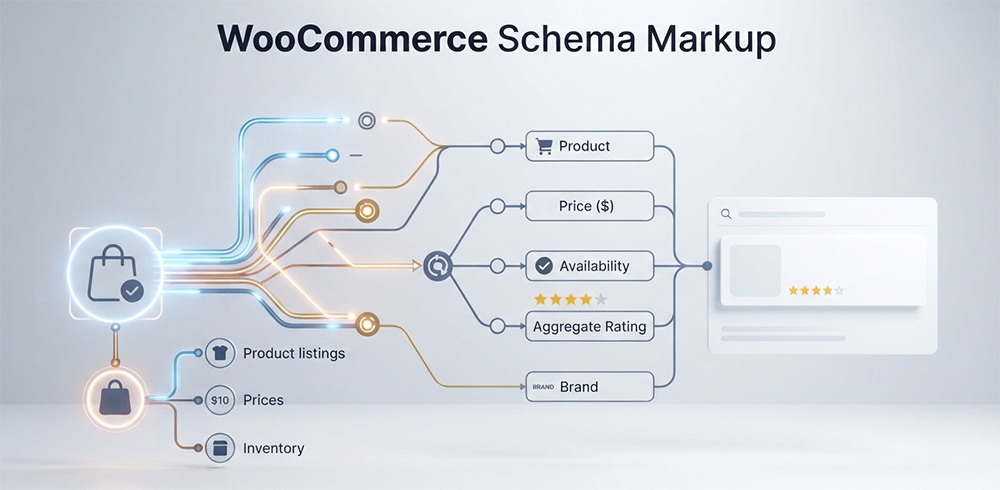
Without suitable product structured data, Google can read all of this information as part of the page. However, the search engine has to interpret what each piece of information represents. A number such as 249 could be a price, a model number, a product code or something else depending on the surrounding content.
With correctly implemented WooCommerce schema, the page can provide structured information identifying the item as a product, the price as an offer price, EUR as the currency, and the current availability as in stock. Where the page meets Google’s requirements, product information can be eligible for richer appearances in Search.
A search result might therefore have the opportunity to show additional information such as €249, availability and eligible review information directly within the result. Without the relevant structured data, the same page may simply appear with its title, URL and a normal text description generated by Google.
That difference is practical. Someone comparing several coffee grinders can potentially see useful purchasing information before clicking through to the website.
There is another detail that matters for an online shop and is often missed. Product information changes. A product that was in stock yesterday might be sold out today, and a price can change during a promotion.
That means WooCommerce schema should ideally be connected to the actual product information rather than manually typed into a block of code and forgotten about. Google specifically notes that dynamically generated product markup can create crawling and reliability issues when important information such as price and availability changes frequently. Google recommends putting product structured data in the initial HTML where possible for merchants concerned with shopping results.
This is one reason we treat WooCommerce schema as part of the website implementation rather than as a one time SEO task. If the shop changes products, prices, stock levels or variants, the structured data needs to continue representing what customers can actually buy.
Schema Markup for Voice Search and AI Results
Voice search is another area where people often hear claims that schema will make their business appear when someone asks a smart speaker a question. The reality is more nuanced.
Search engines and other systems need to understand information before they can use it. Structured data can help machines interpret the content of a page, but it does not guarantee that a particular answer will be selected for a voice response or an AI generated answer.
The same principle applies to Google’s AI search features. Google says its AI features can use information from web sources, while structured data is one of the ways Google can better understand the content of pages. That makes accurate, clearly structured information useful, but it would be wrong to promise that adding schema alone will make a business appear in AI answers.
For a local Irish business, the practical approach is to make important facts easy to understand in several ways. Your website should clearly state what you do, where you operate, who you are, how customers can contact you and any other information that matters to the particular business.
Structured data then gives search engines another machine readable representation of those facts.
For example, a solicitor in Dublin might have pages describing conveyancing, wills and probate. A restaurant in Galway might have pages covering its location, opening hours, menu and booking information. A dentist in Waterford might have pages covering treatments, appointment information and the practice location.
Schema cannot replace useful content on those pages. It works alongside it.
What Good Schema Implementation Looks Like
One of the biggest mistakes we see is treating schema as something that can simply be switched on with a WordPress plugin and then ignored.
Plugins can be very useful, especially when they automatically generate structured data from information already stored in WordPress or WooCommerce. The problem starts when several plugins, a theme and custom development all add their own versions of the same information.
You can end up with duplicate or conflicting structured data. One part of the website might say the business closes at 5pm while another says 6pm. A product might have one price visible on the page and another price in its markup. A business might be described as one type in one place and a different type somewhere else.
These problems are not always visible to a customer looking at the page. That is why validation matters. Google’s own guidance recommends testing structured data, checking how Google sees the URL and allowing time for crawling and indexing after changes are made.
There is also a useful distinction between valid schema and useful schema. A page can contain technically valid structured data that adds very little value because it describes information that is incomplete, irrelevant or poorly matched to the visible content.
For example, adding a generic LocalBusiness object to every page of a website is not necessarily a thoughtful implementation. A location page, contact page and homepage may have a clear relationship to the business entity, while a specific product page needs product information to be the focus.
For larger Irish businesses with several locations, the same principle becomes even more important. Each real physical location can have its own local business information, rather than treating five separate branches as though they were one address. Google’s documentation specifically recommends defining each local business location as a LocalBusiness entity and using the most specific applicable subtype.
There is also a practical benefit to thinking about schema when a website is being redesigned. If the business name, address, services, products and locations are being reorganised in WordPress, it is a good opportunity to make sure the structured data is reorganised at the same time.
Where Schema Fits Into Local SEO in Ireland
For a small Irish business, schema is rarely the first thing we would fix if the website has bigger problems. There is little value in having beautifully structured data on a site that is slow, difficult to use, missing important service information or confusing about where the business operates.
Think of schema as one part of the technical foundation. Your website still needs useful pages, clear information, good internal linking, sensible page titles, strong local relevance and a technically accessible WordPress setup.
Your Google Business Profile also needs to be accurate and maintained. The business name, address, opening hours, phone number, website and other important details should make sense together rather than sending mixed signals.
Once those fundamentals are in place, structured data becomes much more useful because it reinforces information that already exists on the website.
For a local Irish business, that could mean clearly identifying a restaurant and its location. It could mean helping Google understand a particular service business and its contact information. It could mean giving an online retailer clearer product, price and availability information.
The important point is that schema is not really about adding something impressive looking to your website. Most customers will never see the markup itself. They see the consequences of search engines having better information to work with, when Google chooses to use that information in its search features.
That brings us back to the Dublin coffee shop and its €249 espresso grinder. The customer does not care that the product page contains structured data. They care that they can find the right product, understand its price and availability, see useful review information where eligible, and decide whether to click through and buy.
That is the sensible way to approach schema markup Ireland. It is not a trick for forcing Google to display your business in a particular way. It is careful communication between your website and the systems trying to understand it. When that communication is accurate, connected to the real information on your site and maintained as the business changes, it becomes a useful part of a properly built WordPress website.
