You spent months planning the new website.
The old site was dated, difficult to update, and no longer reflected the quality of the business. You worked with a designer, reviewed layouts, replaced old pages, improved the branding, and finally launched the new version.
It looked great.
Then, about two weeks later, you opened your analytics.
Organic traffic was down.
Not dramatically at first. Just enough to make you notice. A few important pages were getting fewer visitors. Some search positions had slipped. Leads from search seemed quieter than usual.
You refreshed the report because surely there had to be another explanation.
This is where many business owners start asking, why did my website traffic go down after we finally launched a better website?
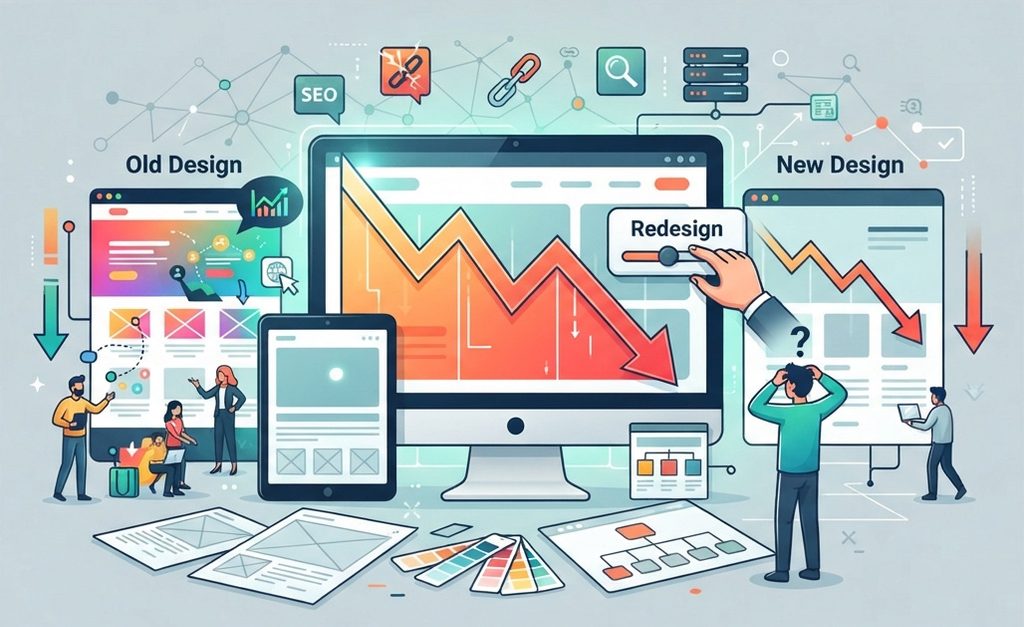
A redesign can cause a drop in search traffic, but that does not mean redesigning a website is bad for SEO. Search engines do not care that the new site looks better. They care about what changed underneath it.
If important URLs disappear, content is removed, internal links change, redirects are missing, or important technical signals are lost, search engines may have trouble understanding the new site.
Things To Do For Proper Website Redesign
The good news is that many of these problems are preventable. Some traffic changes after a redesign are also temporary and recover naturally as search engines recrawl the website.
The important part is knowing the difference.
Why Can a Website Redesign Cause Traffic to Drop?
A website redesign changes much more than the appearance of your pages.
Even if you keep the same business, products, services, and domain name, the redesign may change hundreds of things that search engines use to understand the website.
The URLs might change. Page titles might be rewritten. Content might be shortened. Navigation might be reorganized. Internal links might disappear. Images might become larger. Important pages might be merged or removed.
From your perspective, these can feel like normal parts of rebuilding a website.
From a search engine’s perspective, the website may suddenly look very different.
That is why traffic dropped after website redesign is such a common concern. The redesign itself is not necessarily the problem. The problem is often that SEO signals from the old website were not properly carried into the new one.
URLs changed without proper redirects
This is one of the biggest risks during a redesign.
Imagine your old service page was:
example.com/services/accounting
After the redesign, someone decides the new structure is cleaner, so the page becomes:
example.com/accounting-services
The new URL may be perfectly reasonable.
The problem is that search engines already know the old URL. Other websites may link to it. Customers may have bookmarked it. It may have earned rankings and authority over several years.
If someone visits the old address and it simply returns an error page, the connection between the old page and the new page has been lost.
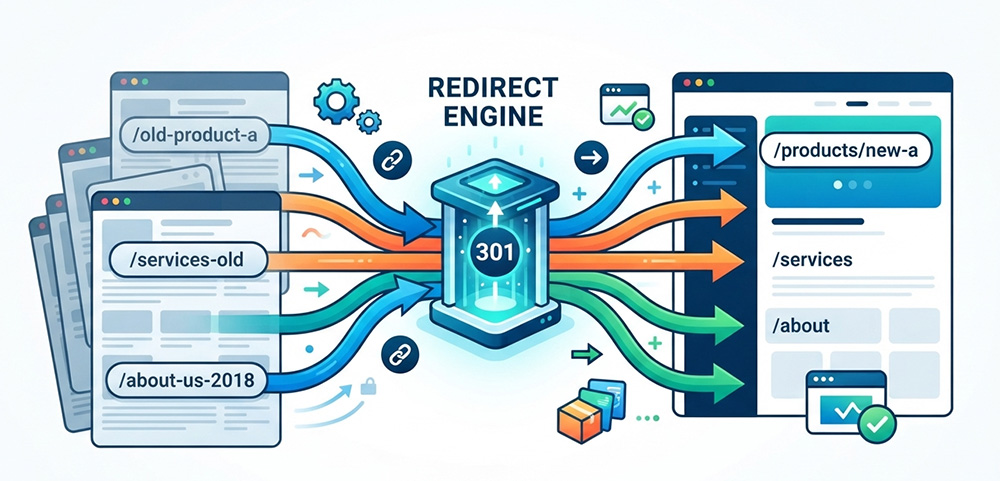
This is why redirects after website redesign need to be planned before launch, not added weeks later after traffic has already fallen.
A proper redirect tells browsers and search engines that the old page has moved and identifies the new location.
This is particularly important for pages that already receive organic traffic or have valuable backlinks.
Changing a URL is not automatically harmful. Changing a URL without properly connecting the old location to the new one is where the trouble starts.
Page titles were changed without considering what already worked
A redesign often comes with a fresh approach to content.
That can be a good thing.
But there is a difference between improving an existing page and completely discarding the information that helped it rank.
Suppose an old service page consistently appeared for an important search term. During the redesign, someone writes a shorter, more polished headline because it looks better in the new design.
The old page title might have clearly described the service and matched what people were searching for. The new title might sound more creative but give search engines less context.
The same can happen with meta descriptions.
Meta descriptions are not a direct ranking factor in the traditional sense, but they can influence how a page appears in search results and whether someone chooses to click it.
A website redesign should not treat every existing title and description as something that needs to be replaced simply because the website has a new visual identity.
The better question is, what was already working, and how can we improve it without throwing away useful signals?
Important content was shortened or removed
This happens more often than many business owners realize.
The old website may have had detailed service pages, product information, location pages, FAQs, guides, or other useful content.
Then the redesign begins.
Someone decides the pages look too text heavy.
The new version uses shorter paragraphs, larger images, and a much cleaner layout.
Visually, the result may be better.
From an SEO perspective, however, removing large amounts of relevant content can change what the page is able to rank for.
This does not mean every old page needs to remain exactly as it was. Some content may genuinely be outdated, repetitive, or unnecessary.
But if a page has been attracting search traffic for years, there should be a reason before removing the information that made it useful.
A website redesign is a good opportunity to improve content.
It is not a good reason to delete valuable content simply because the new design has less room for it.
The site structure changed
Search engines need to understand the relationship between pages.
Your navigation, categories, internal links, breadcrumbs, and page hierarchy all help establish that relationship.
A redesign can change this without anyone realizing the SEO implications.
Maybe your old website had a clear path from the main services page to individual service pages. The new design puts those pages somewhere else.
Maybe important category pages are no longer linked from the main navigation.
Maybe internal links that connected related articles and service pages were removed because the new content management system did not carry them over.
These changes can affect how search engines discover and understand your pages.
They can also affect how authority flows through the site.
A page that used to be one click away from the homepage might now be buried several levels deeper.
That does not automatically mean the page will stop ranking, but enough structural changes can make a noticeable difference.
The new website is actually slower
This one surprises business owners.
The new website looks faster because it is cleaner. It has better animations, larger images, interactive sections, video backgrounds, and a more sophisticated design.
But when you measure it, the pages take longer to load.
A redesign can introduce heavier images, additional scripts, page builders, animations, tracking tools, fonts, and third party integrations.
The result can be a website that looks significantly better while providing a worse technical experience.
This matters because page performance is part of the overall experience search engines evaluate.
More importantly, visitors do not care why the page is slow.
They click, wait, and either stay or leave.
A website redesign should therefore measure website performance before launch and after launch. “It feels faster” is not a reliable performance test.
What If Your Rankings Dropped After Redesign?
If you are looking at your analytics and thinking that your rankings dropped after redesign, the first thing to do is avoid panic.
A change in rankings does not automatically mean the redesign has failed.
Search engines need time to discover changes, crawl new URLs, process redirects, and update their understanding of the website.
That means some fluctuation is normal after a major redesign.
You might see rankings move around for a while. Some pages may temporarily disappear and then return. Traffic can dip before recovering as the new site is processed.
The important question is what happens next.
A temporary dip can be normal
A small fluctuation shortly after launch is not necessarily a reason to panic.
Search engines may crawl different parts of the site at different times. Some changes can be reflected quickly while others take longer.
If your important URLs are still accessible, redirects are working, content has been preserved, and rankings begin to stabilize, there may not be a serious problem.
Give the new site enough time to be crawled and indexed before judging the redesign solely on a few days of data.
At the same time, “wait and see” should not become an excuse for ignoring obvious problems.
A continuing decline needs investigation
The situation deserves closer attention when the decline continues and there are clear technical or structural changes behind it.
For example, if old URLs now return error pages, that is something to fix.
If pages that ranked strongly before the redesign have completely disappeared from search results, investigate why.
If important pages were removed, rewritten substantially, or replaced with unrelated pages, compare the old and new versions.
If organic traffic continues falling for several weeks instead of beginning to stabilize, do not simply assume Google needs more time.
A redesign can expose problems that were introduced during development.
That is the difference between a normal adjustment period and a redesign that has lost important SEO foundations.
What Should Have Happened Before the Redesign?
The safest web redesigns begin with the old website, not the new design.
Before anyone starts replacing layouts, there should be a clear understanding of what the existing site already has and what is worth protecting.
Audit the existing URLs and ranking pages
Start by creating a complete picture of the current website.
- Which URLs exist?
- Which pages receive organic traffic?
- Which pages rank for valuable searches?
- Which pages have backlinks?
- Which pages generate leads or sales?
- Which pages are important even if they do not currently receive much traffic?
This gives the redesign team something much more useful than a sitemap alone.
It shows which parts of the existing website already have value.
A page that looks insignificant from a design perspective might be one of the most valuable SEO assets on the entire website.
Map old URLs to new URLs
If URLs need to change, plan the relationship between the old and new addresses before the website launches.
For example, if five old service pages are being replaced by five new service pages, each old page should have a clear destination.
This should not be left to guesswork after launch.
A URL mapping document can make this much easier. It creates a clear record of what existed before and where each important page is going.
The redirect plan should then be tested before the new website becomes public.
Preserve content that already works
A redesign should ask whether existing content can be improved rather than assuming it needs to be replaced.
Look at pages that already rank.
Look at pages that attract visitors.
Look at pages that answer customer questions.
Look at pages that generate enquiries.
Those pages have already proven that they can provide value.
They may need better writing, clearer structure, stronger calls to action, better images, or a more modern layout.
But removing useful content without understanding its role creates unnecessary SEO risk.
Check page speed before launch
Performance should be part of the redesign process from the beginning.
Do not wait until the new website is live to discover that the homepage is much heavier than the old version.
Test important templates during development.
Check the homepage, service pages, product pages, category pages, blog posts, and other important page types.
The goal is not to chase a perfect score on one testing tool.
The goal is to make sure the new website is not introducing unnecessary performance problems.
A beautiful website that takes too long to load is not an upgrade for the person waiting for it.
Your Website Redesign SEO Checklist
Before launching a redesigned website, make sure someone has checked the things that can cause the biggest problems.
The point of a checklist like this is not to turn a redesign into a huge SEO project.
It is simply a way to make sure the new website does not accidentally throw away value that the old website spent years building.
What If Your SEO Was Lost During the Redesign?
If you are already seeing a major decline, do not immediately start changing everything again.
First, find out what changed.
Compare the old and new URLs.
Look at your highest traffic pages from before the redesign and see whether they still exist.
Check whether those URLs redirect correctly.
Compare the old and new content.
Look at internal links.
Check whether important pages can still be crawled and indexed.
Review page titles and other important on page information.
Check the new site’s performance.
Then look at the timing.
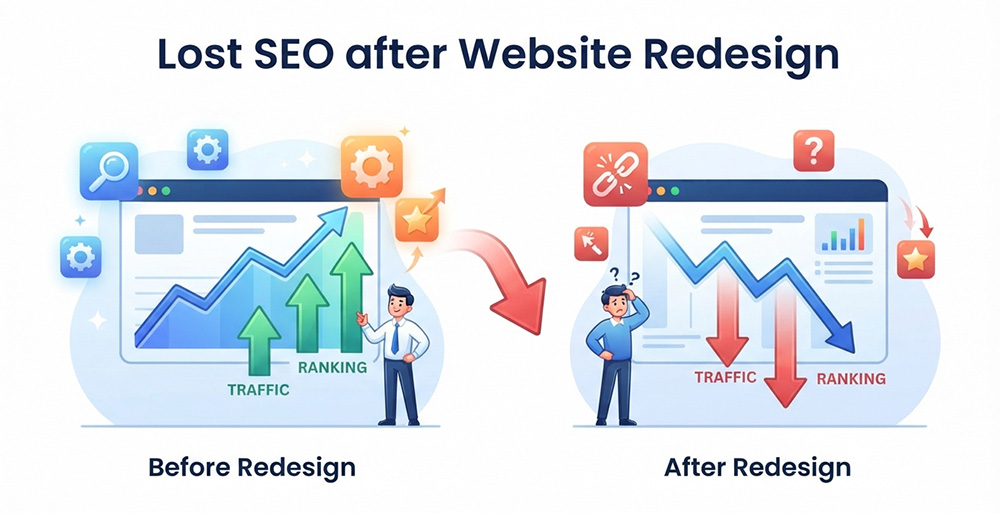
If rankings dropped immediately after launch, something introduced during the redesign deserves particular attention.
If rankings have moved gradually over several weeks, there may be several factors involved.
The goal is to identify the cause before making another round of changes.
Blindly changing titles, adding content, installing SEO plugins, or rebuilding pages can make diagnosis harder rather than easier.
What Happens If You Ignore the Problem?
A small traffic decline can become much more expensive if nobody investigates it.
Organic rankings often represent years of work.
A page may have earned backlinks over time. It may have built authority through consistent traffic and useful content. It may rank for dozens of searches that bring potential customers to the business every month.
If those signals are lost during a redesign and never properly recovered, you are not simply dealing with a temporary dip.
You may have to rebuild visibility that took years to establish.
That can mean months of lost organic leads.
It can mean fewer enquiries, fewer sales, and less exposure to people who were already searching for what you offer.
There is another problem too.
While your rankings are falling, competitors do not wait.
If their pages continue ranking while yours disappear, they have an opportunity to capture the visitors and enquiries that used to find you.
That is why SEO protection should happen before a redesign launches, not after the traffic report starts looking worrying.
How to Redesign a Website Without Losing Rankings
There is no way to promise that a redesign will cause absolutely no ranking movement.
Search results change. Search engines recrawl websites at different speeds. A major redesign can naturally cause some fluctuation.
But there is a big difference between accepting normal movement and creating unnecessary risk.
The goal of website redesign without losing rankings is to preserve the things that already work while improving the things that do not.
That means understanding the existing site before changing it.
- It means planning redirects.
- It means protecting valuable content.
- It means keeping the site’s structure understandable.
- It means testing performance.
And it means monitoring what happens after launch instead of assuming the project is finished the moment the new homepage goes live.
Should You Redesign the Website or Fix the Existing Problems?
Not every traffic decline means the entire website needs to be rebuilt.
- Sometimes the problem is one missing redirect.
- Sometimes important content was accidentally removed.
- Sometimes a group of pages is no longer internally linked properly.
- Sometimes the new site has performance problems that can be fixed without changing the design again.
The right response depends on what actually changed.
This is also why the question “should I redesign my website or start over” can be misleading.
If the redesign itself introduced the problem, starting over without understanding what went wrong can simply create another round of problems.
First understand the damage.
Then decide what needs to be repaired, restored, improved, or rebuilt.
A Better Way to Approach Website Redesign
A website redesign should improve the business without unnecessarily throwing away the value the old website has already built.
That sounds obvious, but it requires the design and development work to happen with the existing website in mind.
At Fiksie, this is the approach behind our website redesign and website optimization services.
The starting point is not simply asking how the new website should look.
It is understanding what the current website is already doing, which pages matter, what should be preserved, and where the existing experience can be improved.
A redesign can be a chance to improve the user experience, modernize the web design, make the site easier to manage, and improve performance.
It should not require you to sacrifice years of search visibility just to get there.
If you are planning a redesign, the question is not whether you should be afraid of losing rankings.
The better question is whether the redesign has been planned carefully enough to protect what you have already earned.
And if your new website has already launched and traffic is falling, do not assume the rankings are gone forever.
In many cases, the problem can be found, understood, and fixed.
The difference is whether someone looks beyond the new design and pays attention to what changed underneath it.
